8 Best Things to See and Do in Askøy, Norway
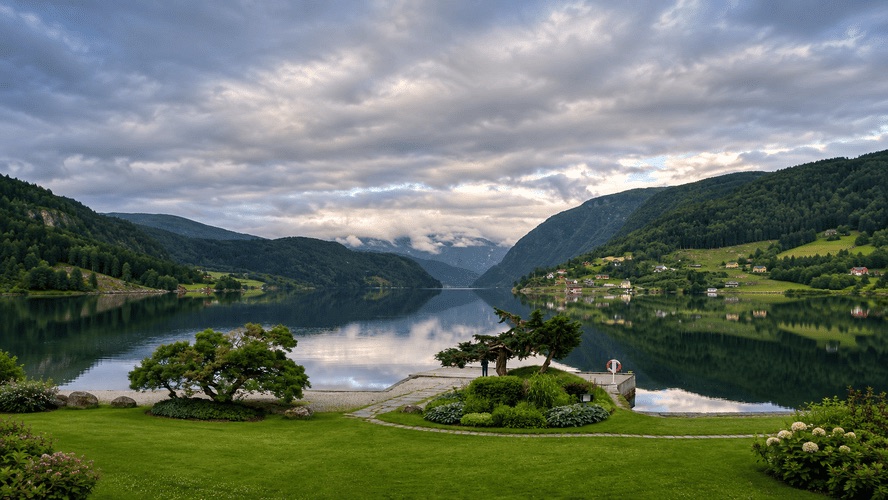
Askøy is an island located northwest of Bergen, in Norway’s Vestland region. Surrounded by Byfjorden, Hjeltefjorden and Herdlefjorden, it combines small coastal villages, forests, beaches and numerous hiking trails.
Its proximity to Bergen and its road connection via the Askøy Bridge make it a good destination for a day trip.
The southern part of the island is home to the main towns and villages, while the north offers quieter, more open landscapes. This is where you’ll find Herdla, a small island known for its nature reserve, beaches and history during the Second World War.
Other highlights include the historic village of Strusshamn, Kolbeinsvarden mountain and the recreational areas of Kollevåg and Siglingavatnet.
If you’re exploring the surroundings of Bergen, here are 8 places to see and things to do in Askøy, along with practical tips to help you plan your visit.
1. Cross the Askøy Bridge

The Askøy Bridge (Askøybrua) is the main road connection between the island and Bergen and one of the most recognisable features of the local landscape.
This suspension bridge crosses Byfjorden and opened in December 1992. It measures 1,057 metres in length, with a main span of 850 metres, making it Norway’s longest suspension bridge until the Hardanger Bridge opened in 2013.
Its two towers reach 152 metres in height, and its main cables are painted blue, an aesthetic choice intended to make the structure stand out against the surrounding landscape.
In addition to vehicle lanes, the bridge has a path for pedestrians and cyclists.
If you’re arriving from Bergen, crossing the bridge is a great way to begin your visit. Along the way, you’ll enjoy views of Byfjorden, the nearby islands and part of Norway’s western coastline.
On the other side lies Kleppestø, Askøy’s main urban centre.
2. Explore Kleppestø and Enjoy Views of Bergen
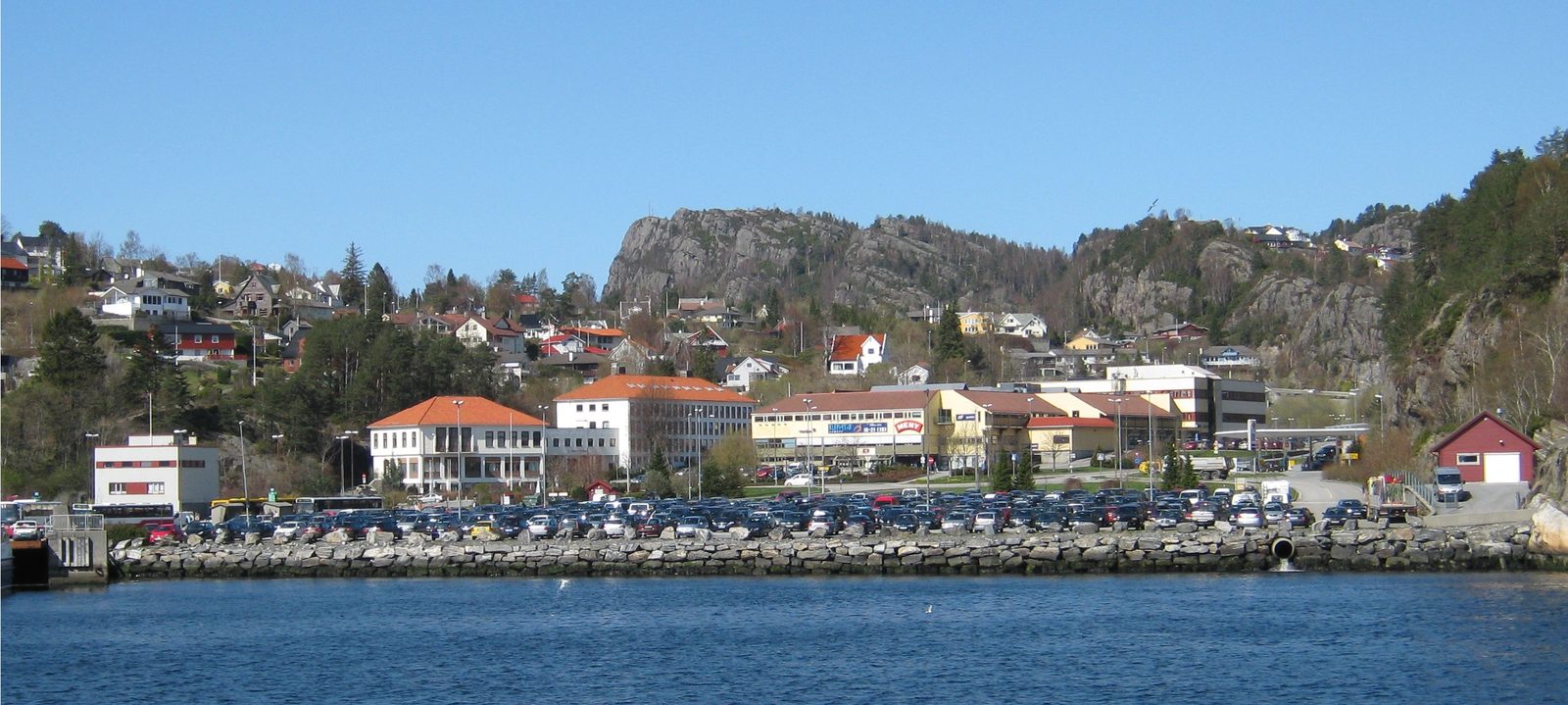
Kleppestø is the administrative centre of Askøy and one of the island’s main towns.
Located on the southeastern coast, opposite Bergen, it has a small harbour, shops, cafés and other services, making it a convenient starting point for exploring the municipality.
Although the town centre is small and doesn’t have major historical monuments, it’s worth visiting the waterfront promenade to enjoy views of Byfjorden and the mountains surrounding Bergen.
The Boat Between Kleppestø and Bergen
One of Kleppestø’s most interesting features is its boat connection with central Bergen.
Skyss route 490 connects Kleppestø quay with Strandkaiterminalen, located right in the centre of Bergen.
The journey takes approximately 15 minutes and offers beautiful views of the city and coastal landscape from the water.
It’s an interesting alternative to driving, especially if you want to take a short trip to Askøy without worrying about parking or road traffic.
The service operates mainly on weekdays and Saturdays, with schedules that may vary depending on the calendar.
You can check departures and buy tickets through the Skyss website.
3. Hike to Kolbeinsvarden, Askøy’s Highest Mountain
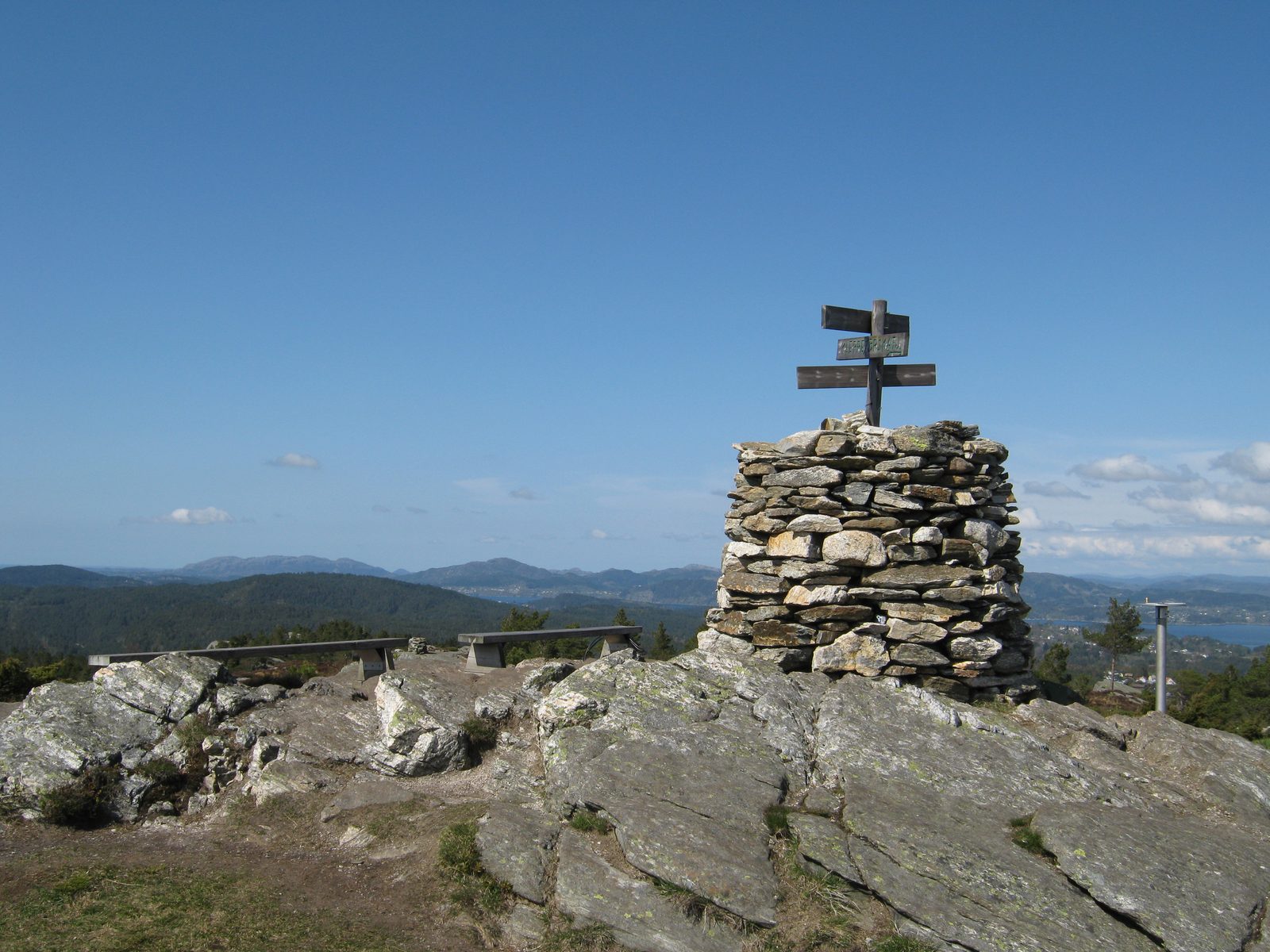
Kolbeinsvarden is the highest point on Askøy, at 231 metres above sea level, and one of the most popular hiking destinations among island residents.
Although its height is modest compared with Norway’s larger mountains, it offers excellent panoramic views of Bergen, the Øygarden archipelago and the mountains of Nordhordland.
At the summit, you’ll find a stone cairn marking the highest point and a wide rocky area where you can stop to enjoy the scenery.
Hiking Route from Bergheim
One of the most common ways to reach the summit is by following the trail that starts in Bergheim, near Kleppestø.
The route passes through wooded areas, small hills and rocky terrain. Wooden boardwalks have been installed along some of the wetter sections to make walking easier.
The hike is approximately 4.8 kilometres round trip, with 219 metres of elevation gain and an estimated walking time of one and a half hours.
It’s classified as a moderate hike, mainly because of the slopes and some rocky sections that can become slippery after rain.
The trail is marked, and parking is available near the starting point.
You can complete the hike during much of the year, but it’s best to avoid snowy or icy conditions unless you have suitable equipment.
You can find the route description and map on UT.no.
4. Discover Strusshamn, One of Askøy’s Oldest Villages
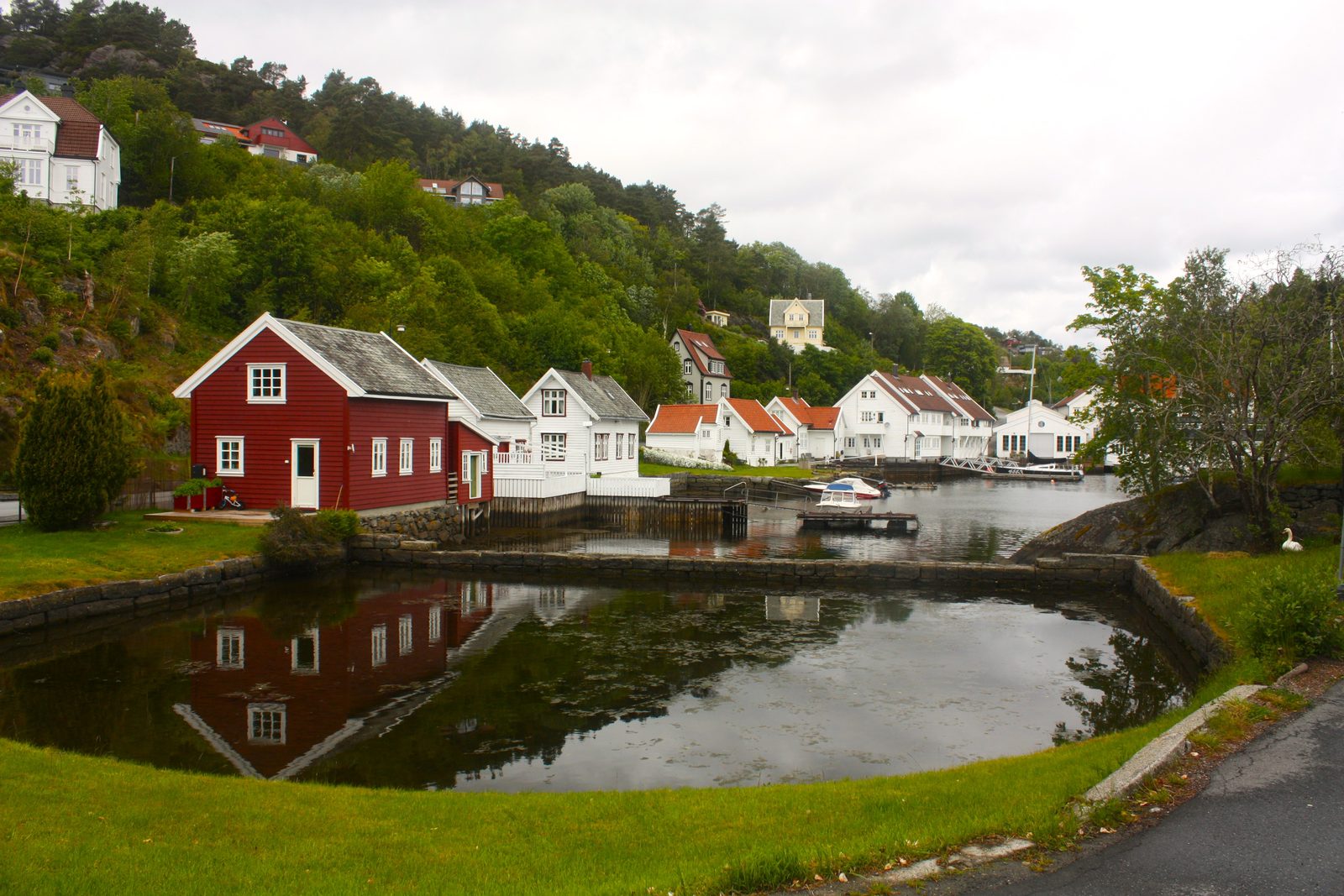
Strusshamn is one of the most charming places on Askøy, located in a sheltered bay in the southern part of the island.
Its harbour preserves a collection of traditional wooden houses, mainly from the 18th and 19th centuries, reflecting the village’s historical importance as a maritime trading centre.
For centuries, Strusshamn was a stopping point for ships travelling towards Bergen.
Its sheltered location encouraged the development of inns, warehouses and trading activities.
It was also Askøy’s first administrative centre. In 1838, the first municipal council meetings were held in an old village inn.
What to See in Strusshamn
The best way to explore Strusshamn is to walk through the streets surrounding its small harbour, where you’ll still find numerous traditional wooden buildings painted in white and reddish tones.
Some of the most interesting places include:
- Strusshamn Church: The current building was consecrated in 1969 and replaced two earlier churches destroyed by fires. The first church was built in 1741.
- The old mill: In 1804, preacher and businessman Hans Nielsen Hauge promoted the construction of a grain mill that helped develop the village’s industry.
- Sjoddien: A former factory connected to the textile industry, now part of the municipality’s cultural heritage and used for activities and events.
The harbour area also preserves other historic buildings and structures that reflect the village’s fishing and industrial past.
Strusshamn is a good place to combine with Kleppestø and Kolbeinsvarden, as all three are relatively close to each other.
You can learn more about its history on the Askøy Municipality website.
5. Visit Ask Church and Discover the Island’s History
Ask is a small village on the eastern coast of Askøy, and it’s where the municipality gets its name.
Its origins are connected to an old farm that played an important role during the Middle Ages and is mentioned in the Norse sagas.
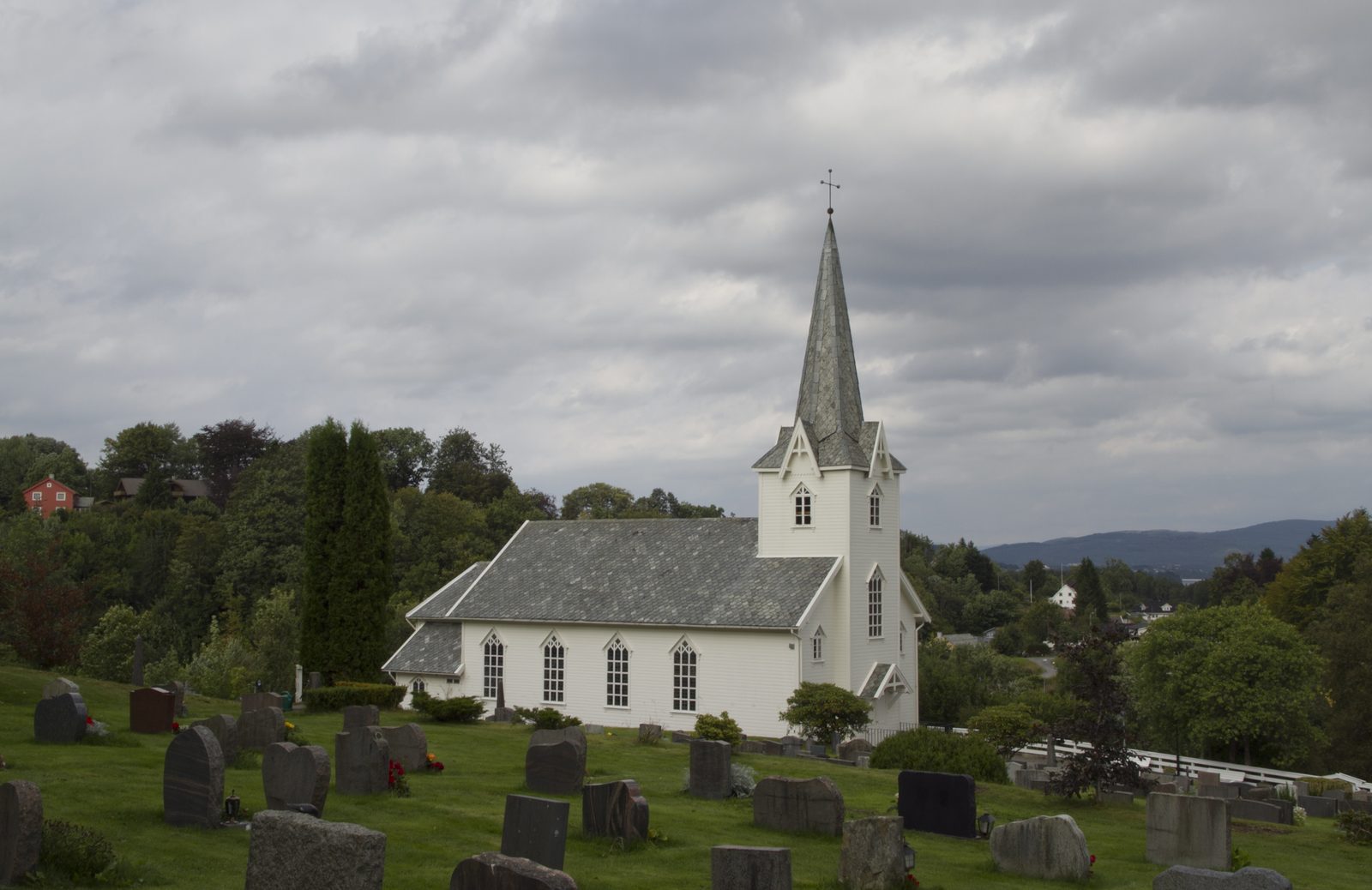
One of the village’s main attractions is Ask Church (Ask kirke), a wooden church built in 1908 and designed by architect Hartvig Sverdrup Eckhoff.
The church stands out for its white façade, tower and small surrounding cemetery.
Although the present building dates from the 20th century, the village’s religious history goes back much further.
The existence of a medieval church was documented as early as 1320, although there was probably a church here from the 12th century.
In 1936, a stone cross was placed on the former Minde farm in Kirkevik to commemorate that first church. However, its exact location remains a subject of debate.
Ask and Its Medieval Past
During the Viking Age, Ask was connected to important families in the region.
The sagas mention the village in the story of Egil Skallagrímsson, one of the best-known figures in medieval Icelandic literature, whose life involved family conflicts and inheritance disputes.
Ask is also believed to have been an estate connected to the Norwegian monarchy.
If you’re interested in learning more about this period, you can read our article about Viking history.
The Strawberries of Ask
In addition to its historical heritage, Ask is known for its traditional strawberry cultivation, known locally as askebær.
Strawberry production has become one of the village’s defining traditions, particularly during summer.
If you visit during the harvest season, you may find locally grown strawberries for sale in nearby shops and stalls.
6. Spend a Day in Herdla: Nature and History
Herdla is one of the most interesting places on Askøy and one of the best day trips from Bergen for travellers interested in nature and Second World War history.
It’s a small island located at the northern end of the municipality, connected to Askøy by Herdlesund Bridge.
Unlike much of the surrounding coastline, which is dominated by rocks and small hills, Herdla has a relatively flat landscape with large open spaces and long pebble beaches.
Its unusual geography has glacial origins. The island was formed from materials deposited by glaciers and meltwater at the end of the last Ice Age.
This natural environment makes Herdla particularly suitable for walking, birdwatching and enjoying the coastal landscape.
Herdla Church
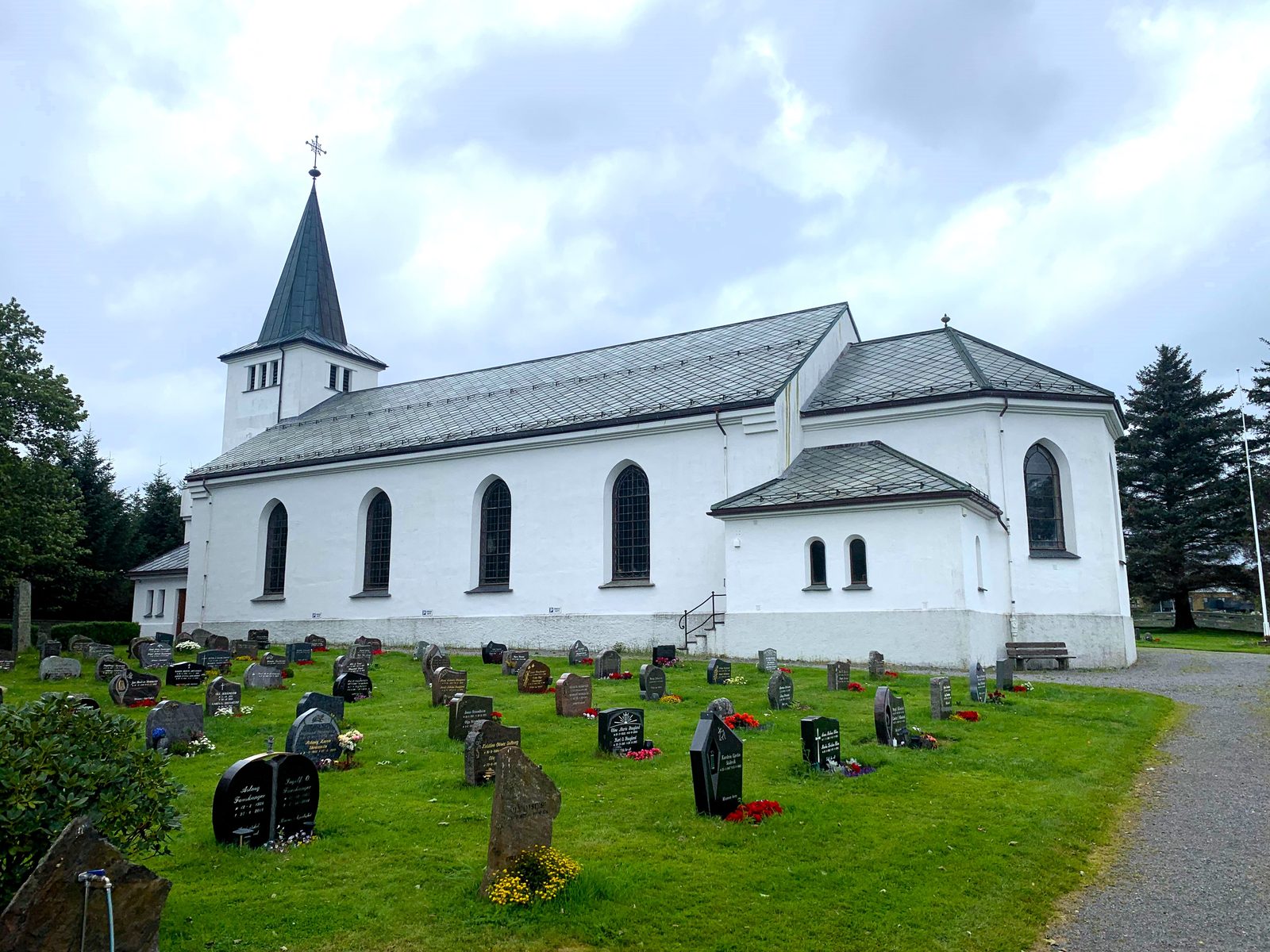
One of Herdla’s main historical landmarks is Herdla Church (Herdla kirke), whose history dates back to the Middle Ages.
The first documented reference appears in 1146, in a letter from Pope Eugene III.
The present stone building dates from 1863, although it has undergone significant changes over the years.
During the Second World War, the island was occupied by German forces and transformed into an important airbase.
The church was used for military purposes, and its tower was destroyed because it served as a landmark for Allied aircraft.
After the war, the church was restored and reconsecrated in 1951. Its tower was returned to its historical height in 2008.
Today, the church is one of the most important reminders of Herdla’s religious and military history.
Herdla Museum and Second World War Remains
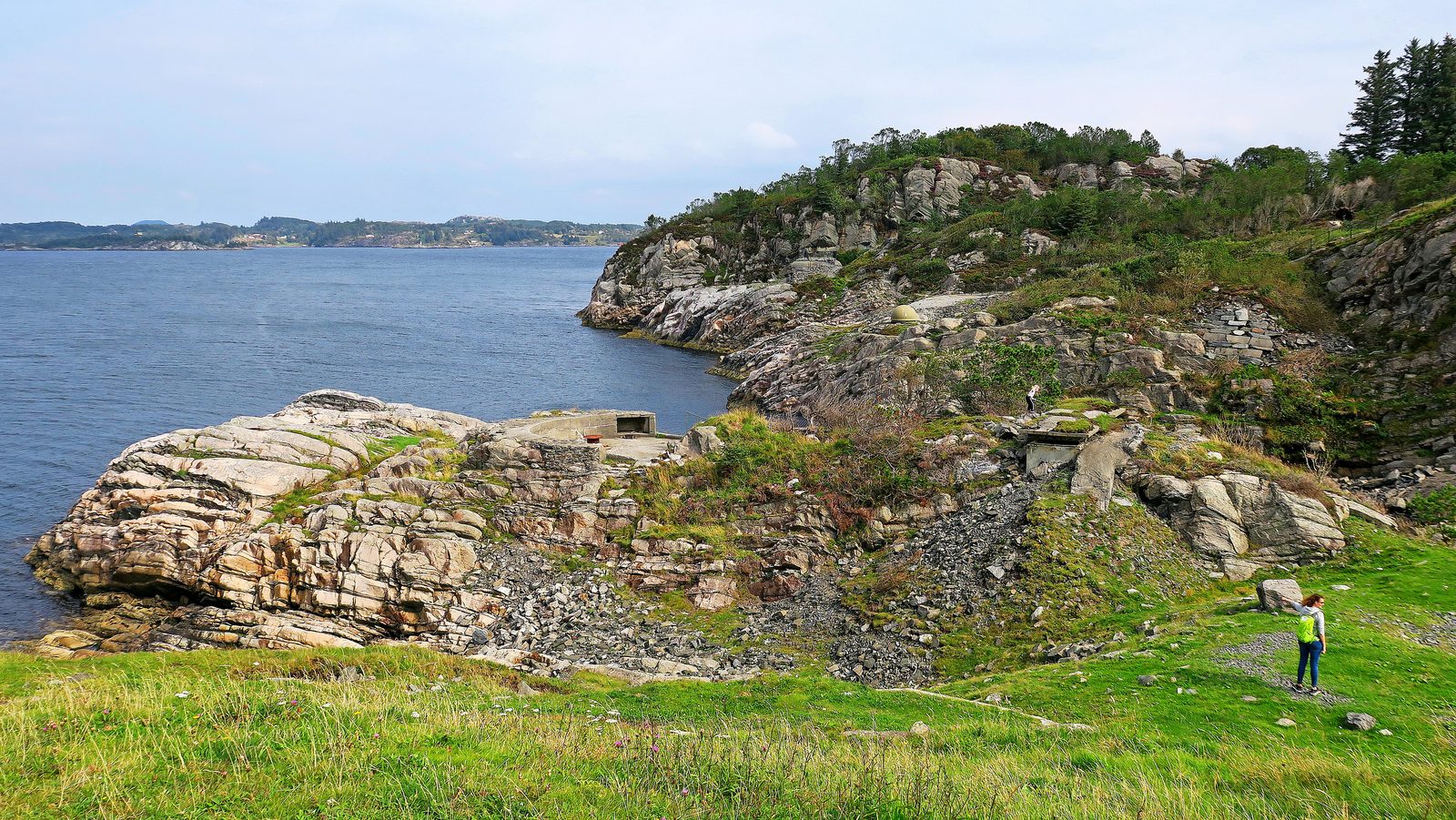
During the German occupation, Herdla played an important strategic role because of its location at the maritime entrance to Bergen.
German forces built an airfield and numerous defensive installations, some of which can still be seen in the landscape.
To learn more about this history, you can visit Herdla Museum, located at the island’s former fort.
Its exhibitions explain how Herdla changed during the war and how its residents lived before and after the occupation.
One of the museum’s most remarkable exhibits is Gul-16, a German Focke-Wulf Fw 190 fighter aircraft that took off from Herdla in December 1943 and crashed into the sea.
The aircraft was recovered decades later and is now preserved in an exhibition dedicated to its history.
The museum also organises guided tours of the former torpedo battery, a military installation used during the Cold War.
Practical Information About Herdla Museum
The museum is located at Herdla Fort, where you’ll also find parking and recreational areas.
Opening hours change throughout the year.
During part of the summer, it’s generally open every day except Mondays, while opening hours are more limited in autumn and winter.
General admission is currently 130 NOK, with discounts for students and free entry for visitors under 18.
Always check the latest opening hours, prices and guided tour availability on the official Herdla Museum website.
Birdwatching in Herdla Nature Reserve
Herdla is also one of the most important coastal bird habitats in Vestland.
Its beaches, wetlands and shallow waters provide valuable feeding and resting areas for many migratory species.
More than 240 bird species have been recorded here, including different types of waders, ducks and gulls.
One of the best places to observe them is Valen, in the northeastern part of the island, where there’s a birdwatching observatory.
Spring and autumn are particularly interesting times to visit, as they coincide with bird migration.
Important: Access to certain parts of the nature reserve is restricted between April 15 and September 30 to protect breeding birds.
It’s essential to stay on authorised paths and follow the signs.
Beaches and Outdoor Activities
In addition to the museum and nature reserve, Herdla has several recreational areas where you can spend a few hours outdoors.
One of the highlights is Vestrefjæra, a long pebble beach on the island’s western coast.
You can also walk along the paths around the former fort, play disc golf or enjoy views of the nearby islands.
The area also has a BUA service, which allows visitors to borrow sports and recreational equipment free of charge.
Herdla also has a golf course and other activities available during the tourist season.
How to Get to Herdla
The drive from central Bergen takes approximately 50 minutes.
The route crosses Askøy Bridge and continues along Road 562 towards the northern end of the island.
Skyss also operates bus services, although departures are less frequent than those serving the southern towns.
If you want to visit the museum, church and nature reserve, I’d recommend spending at least half a day in Herdla.
7. Enjoy Kollevåg Beach and Other Swimming Areas
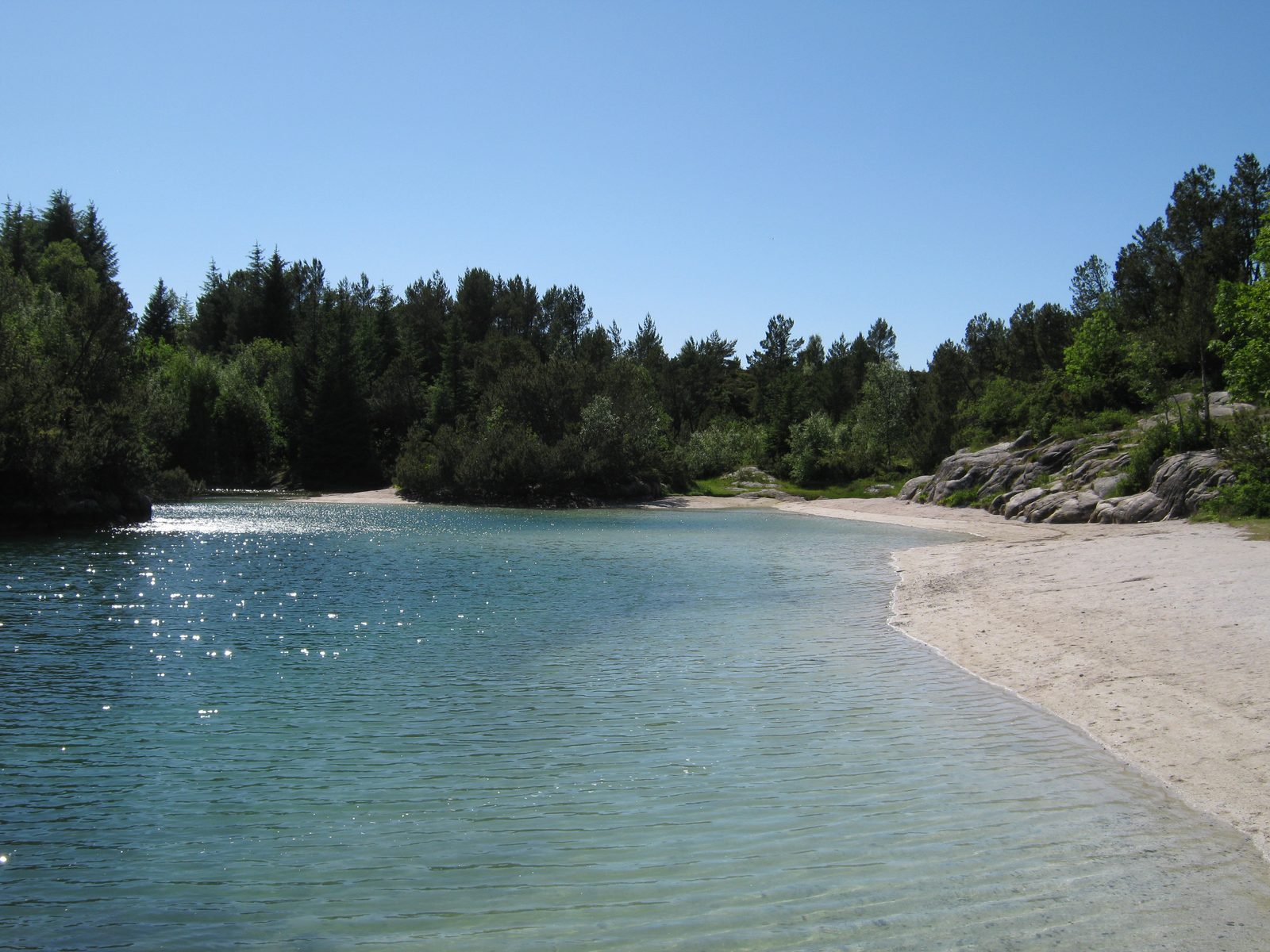
Askøy has numerous small coves and recreational areas where you can enjoy the coast during summer.
Although the sea remains relatively cold even during the warmest months, many of these places are popular with local families for walking, relaxing and spending time outdoors.
Kollevåg
Kollevåg is one of Askøy’s best-known recreational areas, located on the western side of the island.
Its coastline combines small light-sand beaches, rocky areas and green spaces where you can enjoy a picnic or relax beside the sea.
It’s a pleasant place for a walk and to enjoy the coastal scenery, particularly when the weather is good.
The area occupies the site of a former landfill that was converted into a recreational space and remains subject to environmental monitoring.
Before swimming, check local recommendations about water quality and any temporary warnings.
Solnes
Solnes is another swimming area recommended by Askøy Municipality.
It’s located in a landscape of small coves and rocky coastline, partly sheltered from the winds of the open sea.
It’s a good option for anyone looking for a peaceful place to relax and enjoy the coast.
According to published results, the municipality lists Solnes among the swimming areas with excellent bathing water quality.
Skorpo
Skorpo is another coastal recreational area, with small islets and sheltered waters.
Its landscape is particularly attractive for visitors who want to enjoy nature or explore the coastline in a small boat.
If you’re travelling by car, it’s worth choosing the beach that best fits your route, as swimming areas are spread across different parts of the municipality.
You can check access information and bathing water conditions on the Askøy Municipality website.
8. Hike Across Askøy or Walk Around Siglingavatnet
In addition to its villages and beaches, Askøy has numerous hiking trails where you can discover the island’s forests, hills and inland natural areas.
Two of the best-known options are Askøy på langs and Siglingavatnet Recreational Park, although they are suitable for very different types of hikers.
Askøy på langs: A 37-Kilometre Hiking Route
Askøy på langs is a long-distance hiking route that crosses the island from south to north.
The trail starts in Kleppestø and finishes in Herdla, covering approximately 37 kilometres through forest paths, hills and open landscapes.
Along the way, it climbs some of the island’s highest points and passes through a variety of natural environments.
Every May, a sporting event takes place along this route, but you can also complete the hike independently at other times of year.
The full route requires good physical fitness and experience with long-distance walking.
If you prefer a shorter excursion, you can follow one section of the trail and return to your starting point.
Siglingavatnet: A Family-Friendly Walking Route
For an easier excursion, a good alternative is Siglingavatnet Recreational Park (Siglingavatnet Friluftspark).
This natural area is located inland on Askøy, around a small lake surrounded by forests.
The park has maintained walking trails, an illuminated track and places to rest.
One of its main routes is a circular walk of approximately 5.2 kilometres, suitable for visitors who want to spend a few hours outdoors without tackling major elevation changes.
Along the way, you’ll find old peat structures, picnic areas and other features connected to the island’s rural heritage.
Recreational activities are also organised on the lake, including canoe borrowing or rental, depending on availability.
How to Get to Siglingavatnet
The park has its own parking area.
You can also begin your walk from Heiarvang Grendahus, in Nordre Haugland.
It’s a good option for families and anyone who prefers walking through natural surroundings without taking on a demanding mountain hike.
You can find information about the trails and recreational areas on the official Askøy Municipality website.
How to Plan Your Visit to Askøy
Askøy’s proximity to Bergen makes it a convenient destination for a day trip.
However, its main attractions are spread between the southern part of the island and Herdla in the far north.
The most practical approach is to organise your visit by area, especially if you want to combine villages, hiking and natural landscapes.
Route 1: Southern Askøy
This is the most recommended option for a first day trip from Bergen.
Start by crossing Askøy Bridge and continue to Kleppestø, where you can walk along the harbour and enjoy views of Byfjorden.
From there, head to Strusshamn to explore its historic wooden buildings.
If you enjoy hiking, add the climb to Kolbeinsvarden for panoramic views across the region.
During summer, you can also finish your day at Kollevåg or one of the nearby swimming areas, after checking local conditions.
Route 2: Herdla and Northern Askøy
This excursion is particularly recommended for travellers interested in nature and history.
From Bergen, cross Askøy Bridge and continue by road towards Herdla.
Once there, visit the church, explore the museum and walk along the trails around the former fort.
Spend some time birdwatching from the authorised areas of the nature reserve and walking along Vestrefjæra beach.
If you have a full day available, you can combine this visit with stops in some of the small villages in northern Askøy.
How to Get to Askøy from Bergen
By car — Driving is one of the most convenient ways to explore Askøy, especially if you want to visit different parts of the island.
From Bergen, follow Road 562 and cross Askøy Bridge.
The journey to Kleppestø is relatively short, and from there you can continue towards Strusshamn, Ask or Herdla.
The drive from central Bergen to Herdla takes approximately 50 minutes, depending on traffic.
By boat — Skyss route 490 connects Kleppestø with Strandkaiterminalen in central Bergen.
The crossing takes approximately 15 minutes and is particularly convenient if you want to visit Kleppestø and its surroundings without a car.
Timetables and service frequency vary depending on the day of the week and public holidays.
You can check departures on the Skyss website.
By bus — Askøy has regular bus connections with Bergen and between its main towns and villages.
Skyss operates routes connecting Kleppestø, Ravnanger and other parts of the island.
There are also services to Herdla, although they run less frequently.
If you're planning several visits in one day using public transport, it's worth checking waiting times and connections in advance.
You can plan your journeys using Entur, Norway's public transport journey planner.
When Is the Best Time to Visit Askøy?
May to September generally offers the most pleasant conditions for exploring Askøy, especially if you want to enjoy its beaches and hiking trails.
Spring
During May and June, the days become considerably longer and the forests turn green again.
It’s a good time to hike to Kolbeinsvarden and explore the natural areas without the colder temperatures of winter.
Spring is also a particularly interesting time to observe migratory birds on Herdla, as long as you respect the access restrictions in the nature reserve.
Summer
July and August are the best months for enjoying the beaches, taking boat trips and exploring the municipality’s hiking trails.
The weather is generally milder, although sea temperatures remain relatively low.
In Herdla, you’ll find more opportunities to enjoy outdoor activities and visit the museum.
Autumn
During September and October, the forests turn shades of yellow and red, creating particularly beautiful landscapes.
It’s a good time to walk through the coastal villages and observe migrating birds.
However, wind and rain can become more frequent.
Winter
Askøy can be visited throughout the year thanks to its proximity to Bergen and good road connections.
The villages, churches and outdoor attractions remain accessible, although daylight hours are shorter.
Mountain trails may have icy sections, and winds can be strong in coastal areas.
Whatever the season, it’s advisable to bring waterproof clothing and check the weather forecast before outdoor activities.
Sources and Useful Links
- Askøy Municipality — Hiking and Outdoor Activities
- Askøy Municipality — Beaches and Bathing Water Quality
- Visit Bergen — Herdla Day Trip
- Herdla Museum — Official Website
- Kolbeinsvarden — Hiking Route
- Strusshamn — Cultural Centre
- Askøy Bridge — Store norske leksikon
- Skyss — Public Transport Timetables
- Entur — Public Transport Journey Planner